
Daylight Saving Time 2026 USA: Exact Dates, Time Changes, and Digital Marketing Scheduling Tips
Daylight Saving Time in the USA begins on Sunday, March 8, 2026, and ends on Sunday, November 1, 2026. Discover the exact clock-change schedules, state exceptions, and how time shifts impact your global link management and marketing campaigns on GoBitURL.
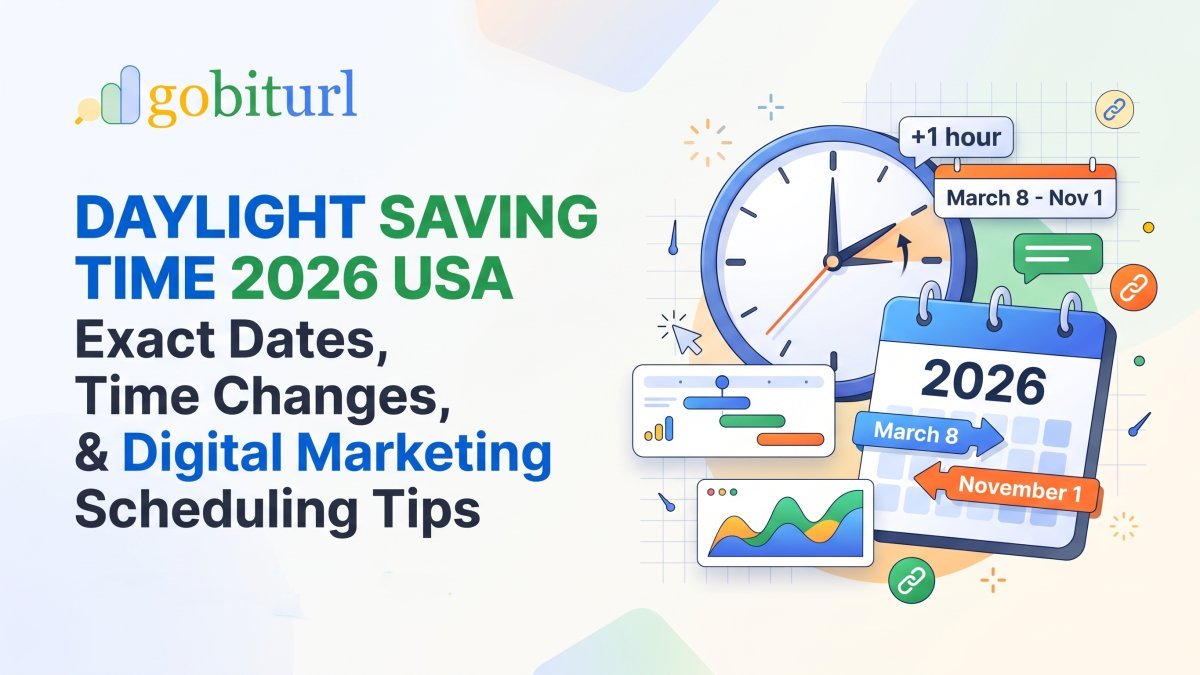
In the United States, Daylight Saving Time (DST) in 2026 begins at 2:00 AM local time on Sunday, March 8, 2026, and concludes at 2:00 AM local time on Sunday, November 1, 2026. Whether you are coordinating cross-country remote teams, planning seasonal product launches, or scheduling time-sensitive shortened links through GoBitURL, missing a one-hour clock shift can throw off your entire digital workflow.
Below is the complete, plagiarism-free breakdown of the 2026 US time change schedule, regional exemptions, and practical strategies to keep your online campaigns synchronized.
Key 2026 Daylight Saving Time Dates in the USA
Under the Uniform Time Act—updated by the Energy Policy Act of 2005—the United States observes Daylight Saving Time starting on the second Sunday in March and ending on the first Sunday in November.
- DST Starts (Spring Forward): Sunday, March 8, 2026. At 2:00 AM local time, clocks jump forward one hour to 3:00 AM. You lose one hour of sleep, but gain an extra hour of evening daylight.
- DST Ends (Fall Back): Sunday, November 1, 2026. At 2:00 AM local time, clocks roll back one hour to 1:00 AM. You gain an extra hour of sleep, and sunrises occur an hour earlier as the country returns to Standard Time.
- Total Duration: 238 days (34 weeks), accounting for roughly 65% of the calendar year.
| Event | 2026 Date | Official Time of Change | Clock Direction | Impact on Daylight |
|---|---|---|---|---|
| DST Begins | March 8, 2026 | 2:00 AM Local Time | Forward 1 Hour (to 3:00 AM) | Later sunrise, later sunset |
| DST Ends | November 1, 2026 | 2:00 AM Local Time | Back 1 Hour (to 1:00 AM) | Earlier sunrise, earlier sunset |
Why People Search for "Day Light Savings" vs. "Daylight Saving"
If you have ever typed day light saving 2026 usa or daylight savings into a search engine, you are in the majority. Grammatically, the official federal term is Daylight Saving Time (singular, with "saving" acting as an adjective modifying "time"). However, in everyday conversation across North America, "daylight savings" and split-word variations like "day light savings" have become the standard colloquial phrasing. Regardless of how you spell it, the federal schedule remains identical.
Which US States and Territories Do Not Observe Daylight Saving Time in 2026?
Not every corner of the United States participates in the twice-yearly clock shift. If your business serves customers in these regions, their local offset relative to the rest of the country will change on March 8 and November 1:
- Hawaii: Remains on Hawaii-Aleutian Standard Time (HST, UTC-10) all year round due to its proximity to the equator, where daylight hours vary very little between summer and winter.
- Arizona (Most of the State): Observes Mountain Standard Time (MST, UTC-7) year-round since 1968 to keep evening temperatures cooler sooner during scorching desert summers. Exception: The Navajo Nation in northeastern Arizona does observe Daylight Saving Time to maintain a unified schedule across its territory in Utah and New Mexico.
- US Territories: Puerto Rico, Guam, American Samoa, the U.S. Virgin Islands, and the Northern Mariana Islands stay on Standard Time throughout 2026.
What Happened to Making Daylight Saving Time Permanent?
Over the last several years, federal proposals like the Sunshine Protection Act aimed to lock clocks into permanent Daylight Saving Time nationwide, while nearly 20 state legislatures passed trigger laws ready to adopt permanent DST if Congress approved it. As of 2026, Congress has not passed the federal amendment required to allow states to stay on permanent Daylight Saving Time. Consequently, the traditional March and November clock shifts remain mandatory for all participating states in 2026.
How the 2026 Time Change Impacts Digital Marketers & GoBitURL Users
When the USA shifts between Standard Time (EST, CST, MST, PST) and Daylight Time (EDT, CDT, MDT, PDT), its offset against Coordinated Universal Time (UTC) changes by an hour. Furthermore, Europe and the UK shift their clocks on different weekends than the United States (the UK and EU spring forward on March 29, 2026, and fall back on October 25, 2026).
Here is how to protect your digital campaigns on GoBitURL during the transition windows:
- Audit Expiring Short Links: If you use GoBitURL to create time-sensitive or expiring promotional links for flash sales, verify whether your expiration timestamp is anchored to UTC or the recipient's local US time zone. A link set to expire at midnight EST will close an hour early or late if scheduled across the March 8 or November 1 threshold without DST adjustment.
- Watch the 3-Week US/Europe Gap: Between March 8 and March 29, 2026, the time difference between New York and London shrinks from 5 hours to 4 hours. If you blast shortened links via SMS or email to international audiences, adjust your automation queues so your links hit inboxes at peak morning engagement hours.
- Analyze Click-Through Analytics Accurately: When reviewing your GoBitURL real-time click analytics on Monday, March 9, or Monday, November 2, remember that hourly traffic spikes will shift by one hour compared to the previous week's baseline.
- Update Bio Links and Event Landing Pages: Hosting a webinar or live stream around the time change? Always label your call-to-action links with the specific time zone designation (EDT between March 8 and November 1; EST after November 1) rather than generic "ET" so attendees click your GoBitURL link at the exact right moment.
Ready to streamline your marketing links across every time zone? Head over to GoBitURL.com to shorten, brand, and track your URLs with precision analytics—no matter when the clocks change.
Frequently asked questions
When is Daylight Saving Time in the USA in 2026?
Daylight Saving Time in the USA starts on Sunday, March 8, 2026, at 2:00 AM, and ends on Sunday, November 1, 2026, at 2:00 AM.
Do clocks go forward or back in November 2026?
On Sunday, November 1, 2026, clocks fall back one hour at 2:00 AM (returning to 1:00 AM), giving Americans an extra hour of sleep as Daylight Saving ends.
Do smartphones and computers update automatically for DST 2026?
Yes. Most modern smartphones, computers, and cloud platforms (including GoBitURL link analytics) automatically update at 2:00 AM local time, provided your device's "Set time automatically" and location settings are enabled. Manual wall clocks, microwaves, and older vehicle dashboards must be changed by hand.
Keep reading
More stories you might like.

Florida Learjet 60 Crash: How Flight Tracker Data Revealed the Final Moments and How to Share Live Aviation Links Safely
Following the tragic Learjet 60 plane crash in Greenacres, Florida, millions turned to live flight tracker platforms for answers. Explore what ADS-B telemetry and ATC audio revealed about flight N722BD, and learn how journalists and aviation analysts use GoBitURL to share clean, trackable radar links during breaking news events.

Spain Train Crashes: Safety Investigations, High-Speed Rail Security, and Lessons from History
Spain operates one of the most extensive high-speed rail systems in the world, yet recent high-speed collisions and historical derailments have placed national infrastructure under scrutiny. This comprehensive report breaks down signalling safeguards, operator protocols, and ongoing safety reforms across Spain’s railway network.

Winter Weather Forecast: Expected Temperatures, Dense Fog (कोहरा) Alerts, and Seasonal Guide
As winter sets in, falling temperatures and dense morning fog (कोहरा) are beginning to impact daily routines and travel. Discover what the seasonal weather forecast predicts for temperature lows this winter and how to stay ahead of extreme weather alerts.
Enjoyed this? Try the tool.
Shorten links, make QR codes and see who clicks — free.
0 Comments
Be the first to comment.
Leave a Comment