
Dead-End Job vs. Dead End Job: Grammar Rules, Meaning, and How to Escape One
Wondering whether to write "dead-end job" or "dead end job"? Learn the simple grammar rule behind this common phrase, the warning signs that you are stuck in one, and practical steps to build a digital career and break free.
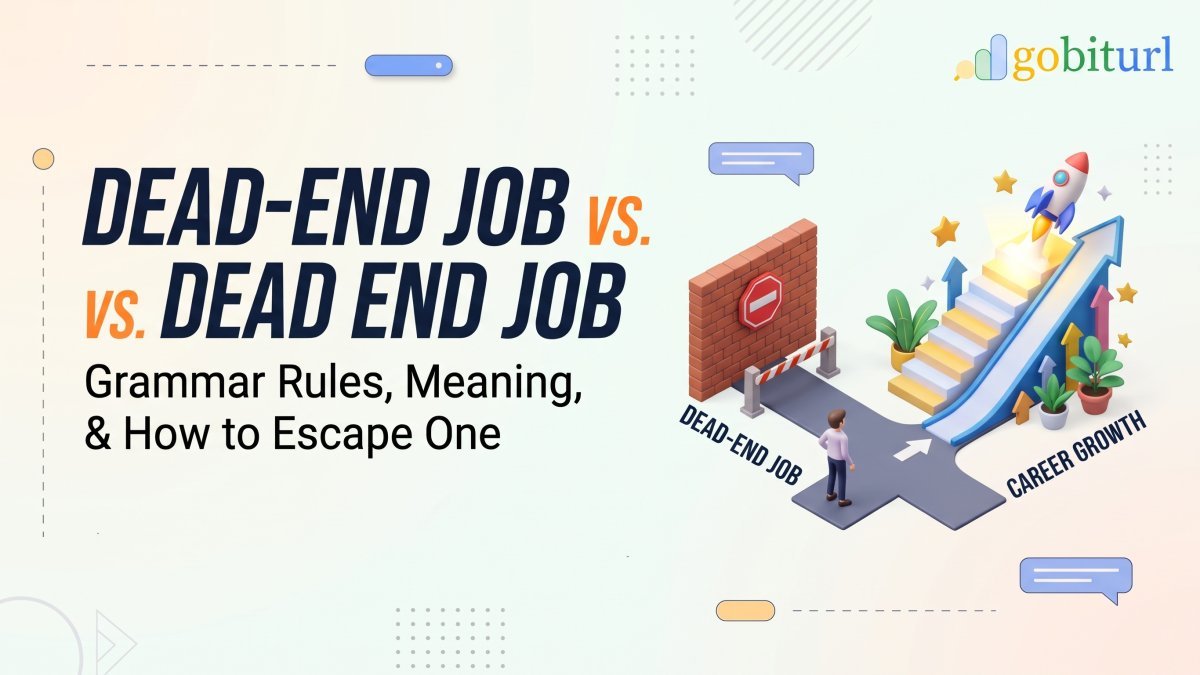
Whether you are updating your resume, writing a cover letter, or venting to a friend over coffee, you might pause and wonder: is it spelled dead-end job or dead end job?
Beyond the spelling, if you are searching for this term, there is a good chance you are also feeling stagnant in your current role. Below is the quick grammatical breakdown, what the phrase actually means in the modern workplace, and how you can pivot toward a career with real upward mobility.
Dead-End Job vs. Dead End Job: Which Is Correct?
The grammatically correct spelling is dead-end job (with a hyphen).
In English grammar, when two or more words work together as a single unit to modify a noun right in front of them, they form a compound adjective. Because "dead" and "end" combine to describe the type of "job," they require a hyphen to link them together.
Here is the simple rule to remember:
- Hyphenate before a noun: "He decided to quit his dead-end job." (Here, dead-end acts as an adjective describing job).
- No hyphen when used as a noun: "He realized his career had reached a dead end." (Here, dead is an adjective describing the noun end).
While people frequently type "dead end job" without the hyphen in search engines and casual text messages, using the hyphen in professional writing, blog posts, and resumes shows strong attention to detail.
What Exactly Is a Dead-End Job?
A dead-end job is any position that offers little to no opportunity for career advancement, skill development, or significant pay increases. It is a role where doing outstanding work merely rewards you with the exact same work tomorrow.
Not every entry-level or temporary position is a problem. Sometimes, a low-stress job with a predictable schedule pays the bills while you study, build an online business, or care for family. A job only becomes a true trap when your personal goals require growth, and your workplace refuses to provide a path forward.
5 Unmistakable Signs You Are in a Dead-End Job
If you are unsure whether you are experiencing a temporary slump or a permanent ceiling, look for these five warning signs:
- There is no clear promotion path: Nobody in your department has moved up in years, or upper management exclusively hires outsiders for leadership roles rather than promoting from within.
- You have stopped learning: You mastered your daily tasks months (or years) ago, and your employer offers zero budget or time for training, certifications, or new tools.
- Your compensation barely beats inflation: Raises are either nonexistent or capped at a tiny annual percentage, regardless of how much value or revenue you generate.
- Your feedback falls on deaf ears: When you ask your manager about taking on bigger projects or charting a long-term career plan, you are met with vague promises that never materialize.
- Sunday nights bring dread, not drive: You feel mentally checked out because you know your effort has no impact on your future trajectory.
How to Escape a Dead-End Job Without Risking Your Income
Quitting on the spot feels dramatic in movies, but in reality, the smartest way out of a stagnant role is a strategic transition. Use the stability of your current paycheck to fund your exit plan.
- Audit your transferable skills: Write down every problem you solve at work—whether it is customer communication, data organization, scheduling, or troubleshooting. These are the building blocks of your next role.
- Upskill in high-demand digital areas: Spend an hour each evening learning skills that aren't tied to a single physical office, such as digital marketing, content creation, analytics, or project management.
- Build your personal brand and online portfolio: Today, recruiters and clients look beyond paper resumes. Whether you are sharing industry insights on LinkedIn, launching a freelance portfolio, or starting a niche blog, controlling how you share and track your links matters. Using a clean URL shortener and link management tool like GoBitURL helps you share polished, trackable links across your social bios, digital resumes, and outreach emails—so you can see exactly who is engaging with your work.
- Start a side project before you leap: Test the waters by freelancing, consulting, or monetizing a digital project on weekends. Once your new skills or side income gain traction, transitioning into a better full-time role—or working for yourself—becomes much easier.
Turn a Dead End Into a Launching Pad
Realizing you are in a dead-end job isn't a failure—it is the clarity you need to make a change. By recognizing the signs early, sharpening your digital skills, and presenting your work professionally online, you can trade a career ceiling for an open runway.
Frequently asked questions
Is it spelled "dead-end job" or "dead end job"?
The grammatically correct spelling is dead-end job with a hyphen. Because "dead" and "end" work together as a compound adjective to describe the noun "job," standard English grammar requires a hyphen. However, when you use the phrase as a noun at the end of a sentence—such as "My career has reached a dead end"—you leave the hyphen out.
What is considered a dead-end job?
A dead-end job is any position that offers little to no opportunity for career progression, skill development, or meaningful salary growth. Even if you consistently exceed expectations, the role has a strict ceiling with no internal pathway to higher-level positions.
Is it ever okay to stay in a dead-end job?
Yes, depending on your current life priorities. A predictable, low-stress role with zero overtime can be an ideal temporary arrangement if you are going to school, caring for family, or using your evenings to build an online business or side hustle. It only becomes problematic when it blocks your financial or professional goals.
How long is too long to stay in a dead-end job?
Once you have mastered every aspect of your daily routine and have gone 12 to 18 months without learning a new skill, taking on new responsibilities, or receiving a merit-based raise, your career has likely plateaued. At that point, it is wise to start planning your next move.
How do I explain a dead-end job on my resume or in an interview?
Never speak negatively about your current employer. Instead, focus on your measurable achievements in that role and frame your reason for leaving around future growth. For example, say: "I have really enjoyed mastering my current responsibilities, and I am now ready to step into a role where I can take on larger challenges and grow long-term with the company."
How can I make my job applications stand out when leaving a dead-end role?
Focus on transferable skills and build a visible online footprint. Create a digital portfolio, optimize your LinkedIn profile, and include clean, customized short links (using a tool like GoBitURL) on your resume and cover letters. Tracking clicks on your portfolio links also helps you see when hiring managers are actively reviewing your application.
Keep reading
More stories you might like.

India Gold & Silver Rate Today (22K/24K Across Major Cities) + How Jewellers Automate Daily Rate Boards
Track today’s 22K and 24K gold and silver prices across Mumbai, Delhi, Chennai, and Bengaluru. Plus, discover how modern Indian jewellery showrooms eliminate manual price board errors by automating daily rate updates with GoBitURL custom short links and QR codes.

Bitcoin Price Today in USD & INR: Market News, Live Trends, and Smart Crypto Sharing
Staying ahead of the cryptocurrency market requires tracking the Bitcoin price across both global USD benchmarks and local INR exchanges. Explore the latest Bitcoin news, current BTC price levels in Dollars and Rupees, and discover how GoBitURL helps traders and creators share cumbersome market links with clean, trackable URLs.
Short Links vs. QR Codes: Which Should You Use for D2C Packaging?
Struggling to decide between short links and QR codes for your D2C product packaging? Discover how to bridge the physical-to-digital gap, boost post-purchase engagement, and track offline conversions using GoBitURL.
Enjoyed this? Try the tool.
Shorten links, make QR codes and see who clicks — free.
0 Comments
Be the first to comment.
Leave a Comment