
Short Links vs. QR Codes: Which Should You Use for D2C Packaging?
Struggling to decide between short links and QR codes for your D2C product packaging? Discover how to bridge the physical-to-digital gap, boost post-purchase engagement, and track offline conversions using GoBitURL.
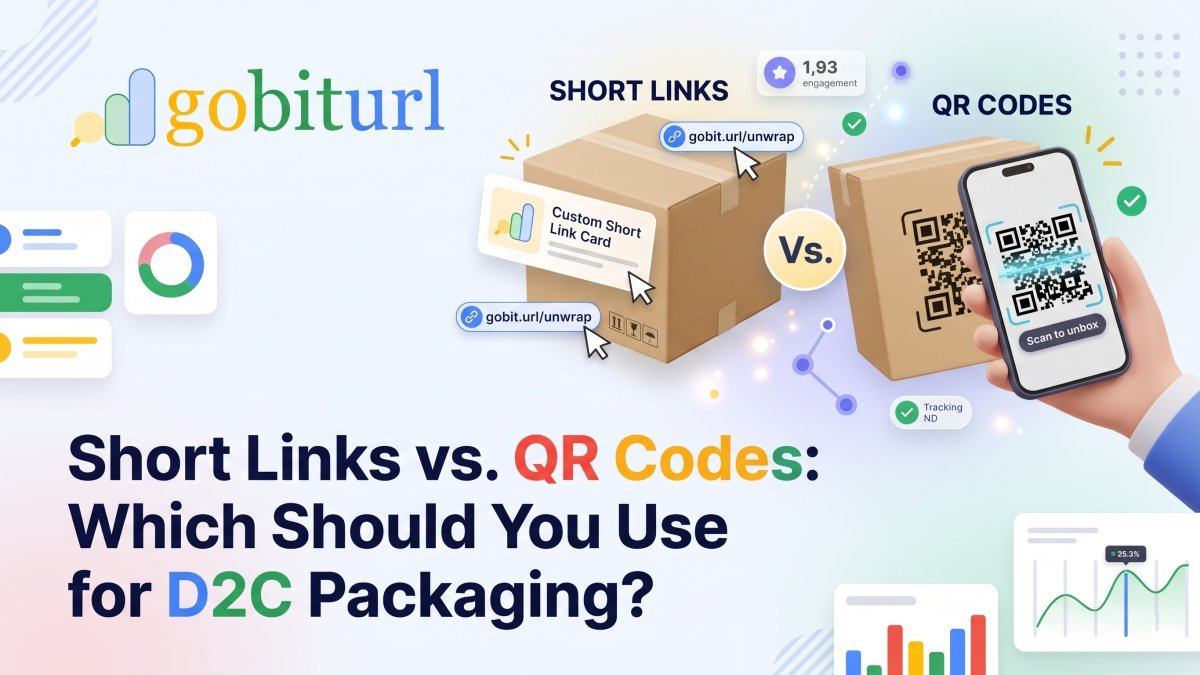
Your customer acquisition cost (CAC) is climbing, paid social algorithms are volatile, and retention is where Direct-to-Consumer (D2C) margins are actually made. Yet one of your highest-impression marketing assets is sitting right in your customer's hands: your product packaging.
Unlike a fleeting Instagram ad or a buried promotional email, physical packaging has a 100% open rate. Every customer who buys your product touches the box, reads the label, or glances at the insert card.
To turn that physical touchpoint into a digital action—whether that is a subscription reorder, a warranty registration, a user-generated content (UGC) submission, or a how-to video—you have two primary tools: Branded Short Links and QR Codes.
Which one belongs on your D2C packaging? Here is a breakdown of how each performs in the real world and how you can use GoBitURL to turn your packaging into a measurable revenue channel.
Why Connected Packaging Matters for Modern D2C Brands
Before comparing the two formats, look at what happens after a box arrives on a doorstep. Once a customer unboxes your product, you risk losing visibility into how they use it—especially if they bought through a third-party marketplace, a retail partner, or a TikTok Shop checkout.
Bridging the offline-to-online gap on your packaging lets you:
- Capture first-party data from retail or marketplace buyers through warranty registrations or discount giveaways.
- Reduce customer support tickets by linking directly to onboarding videos, assembly instructions, or dosage guides.
- Drive automated reorders right when a consumable product (like skincare, coffee, or supplements) is running low.
- Collect reviews and social proof at the peak moment of unboxing excitement.
To capture those actions, friction must be as close to zero as possible.
The Case for QR Codes on Product Packaging
QR codes are the heavyweight champions of mobile convenience. Because modern iOS and Android smartphone cameras scan QR codes natively without third-party apps, the transition from holding a bottle to viewing a mobile webpage takes less than three seconds.
Where QR Codes Excel:
- Zero Typing Friction: Customers do not have to open a browser, type characters on a tiny glass keyboard, or worry about autocorrect breaking a URL.
- Complex Destination URLs: You can send users to deep product pages, pre-filled checkout carts, or multi-parameter UTM links without them ever seeing a messy string of text.
- Dynamic Flexibility: When you generate a Dynamic QR Code using GoBitURL, the printed pattern encodes a short redirect URL rather than a permanent destination. If you print 50,000 boxes and later change your landing page, seasonal offer, or video tutorial, you can update the destination link inside your GoBitURL dashboard in seconds—without reprinting a single box.
Where QR Codes Struggle:
- Curved and Small Surfaces: A lip balm tube, a small essential oil dropper, or a crinkled flexible pouch can distort the square matrix of a QR code, making it impossible for a camera lens to focus and scan.
- Aesthetic Clutter: Minimalist luxury packaging designers often push back against clunky black-and-white pixelated squares unless they are carefully customized with brand colors and logos.
- No Visual Context: A bare QR code without a strong call-to-action (CTA) and branded trust signal leaves customers guessing where the scan will actually take them.
The Case for Branded Short Links on Product Packaging
A branded short link (like go.yourbrand.com/setup or a clean link created on GoBitURL) turns a clunky, forgettable web address into a memorable verbal and visual asset.
Where Branded Short Links Excel:
- Micro-Packaging & Curved Labels: Short links fit effortlessly along the rim of a jar, on the back of a hangtag, or at the bottom of a narrow cylindrical bottle where a QR code would warp.
- Desktop & Multi-Device Users: Not every post-purchase experience happens on a phone. If you sell B2C electronics, home office gear, coffee machines, or hobby kits, many customers prefer typing a clean short URL into their laptop or tablet browser to download software or view full-screen PDFs.
- High Brand Trust & Recall: A readable slug tells the user exactly what they are getting before they even pull out their device. Seeing
yourbrand.link/vipbuilds immediate curiosity and trust, whereas an unlabeled QR code can trigger security hesitation. - Human Readability: If a camera lens is smudged, the room lighting is dim, or the box gets slightly scuffed during shipping, a short link can still be read by the human eye and typed into a browser.
Where Short Links Struggle:
- Typing Effort: Even a 12-character URL requires a customer to unlock their phone, open Safari or Chrome, tap the address bar, and type accurately. Every extra tap drops conversion rates by a few percentage points.
Head-to-Head Comparison: Short Links vs. QR Codes
| Feature | Branded Short Links | Dynamic QR Codes |
|---|---|---|
| User Friction | Moderate (Requires manual typing) | Ultra-Low (Point and tap) |
| Space Required | Minimal (Single line of text) | Moderate (At least 2 x 2 cm recommended) |
| Curved/Crinkled Surfaces | Excellent readability | Prone to scanning failure if warped |
| Desktop Accessibility | Easy to type on laptops/PCs | Requires a mobile camera |
| Visual Trust | High (Readable domain and slug) | Moderate (Needs a frame/CTA for context) |
| Destination Editing | Editable anytime via GoBitURL | Editable anytime via GoBitURL |
Which Should You Choose for Different Packaging Touchpoints?
Instead of treating all packaging the same, match the format to the physical container and customer mindset:
- Outer Shipping Mailers & Corrugated Boxes: Use a large QR code inside the lid alongside a bold unboxing message ("Scan to watch our founder's message" or "Scan to unlock 20% off your next order"). The flat cardboard surface is ideal for quick camera scanning.
- Small Cosmetics, Vials & Cylindrical Bottles: Use a Branded Short Link. Tight curves distort QR matrices, whereas a short, punchy URL printed horizontally or vertically stays legible.
- Thank-You & Insert Cards: Use both. Insert cards sit on flat cardstock where high-contrast printing shines, and customers often keep them on their desks.
- Apparel Hangtags & Care Labels: Use a Dynamic QR Code for care instructions and sustainability stories, backed up by a tiny short URL beneath it in case the tag bends.
The Ultimate D2C Secret: The Hybrid Power Play
The highest-converting D2C brands do not choose between short links and QR codes—they print the branded short link directly underneath the QR code.
Why does this pairing outperform using either one alone?
- Built-In Fail-Safe: If a customer's camera struggles with glare or a damaged box corner, the short link right below the code gives them an instant backup path.
- Psychological Trust: Printing
brand.co/registerdirectly underneath the QR frame reassures hesitant scanners that the code leads to an official, safe destination. - Split-Channel Attribution: By using GoBitURL to assign one tracking parameter to the QR scan and another to the typed short link, you can measure how many of your customers prefer scanning versus typing.
4 Best Practices for High-Converting Packaging Links
- Never Use a Static Link or Static QR Code: Packaging print runs last for months or years. Always manage your packaging links through GoBitURL so you can redirect traffic on the fly if a product page URL changes or a campaign expires.
- Always Anchor With Value: Never print a lonely QR code or URL by itself. Tell the customer why they should act: "Scan for a 60-second brewing guide" converts up to 3x higher than "Scan here."
- Track Batch & SKU Performance: Create unique GoBitURL short links and QR codes for each SKU or packaging batch. You will see inside your analytics dashboard which products drive the highest post-purchase engagement, which cities scan the most, and what time of day customers interact with your brand.
- Test Before You Print 10,000 Units: Always print a 1:1 physical mockup of your label, wrap it around the actual container, and test the QR code under dim indoor lighting on both an iPhone and an Android device before sending files to your packaging manufacturer.
Turn Your Packaging Into a Performance Channel With GoBitURL
Your packaging is already paid for—now make it work as hard as your digital ads. With GoBitURL, you can generate branded short links and customizable dynamic QR codes from a single dashboard, monitor real-time scan and click analytics, and update destination URLs anytime without ever worrying about dead links on printed boxes.
Ready to connect your physical products to your digital storefront? Head over to GoBitURL.com to create your first dynamic packaging campaign today.
Frequently asked questions
What is the difference between a static QR code and a dynamic QR code for product packaging?
A static QR code permanently hardcodes your final destination URL into the black-and-white pattern; once printed, the destination can never be changed. A dynamic QR code (like those created on GoBitURL) encodes a short redirect URL instead. This allows you to change the destination webpage anytime, fix broken links, rotate seasonal campaigns, and track real-time scan analytics without ever reprinting your packaging.
What is the minimum printable size for a QR code on D2C packaging?
For reliable scanning across all smartphone cameras, print your QR code at a minimum size of 2 cm x 2 cm (0.8 in x 0.8 in), including a quiet zone (blank margin) around the border. If your product label has less space than that—or wraps tightly around a narrow tube or vial—use a branded short link instead.
Should I put both a QR code and a short link on my packaging?
Yes. Printing a clean branded short link directly beneath your QR code is the gold standard for D2C packaging. The short link acts as a trust signal showing customers where the scan leads, while also providing a reliable fallback if a box gets scuffed in transit or a customer wants to visit the link on their laptop.
How can I track whether customers scan the QR code or type the short URL?
In GoBitURL, you can either generate two separate short links pointing to the same landing page (one embedded in the QR code, one printed as text) or append distinct UTM parameters (?utm_medium=qr_box vs. ?utm_medium=shortlink_box). Your analytics dashboard will show you the exact split between mobile scans and manual clicks.
What happens if we redesign our website and our product page URLs change after printing 50,000 boxes?
If you used GoBitURL to generate your packaging short links and dynamic QR codes, you simply log into your GoBitURL dashboard and update the destination URL to your new page. Every previously printed box on store shelves or in customers' homes will immediately redirect to the updated link with zero downtime.
Do custom colors and logos inside a QR code hurt scanability?
Not if you maintain strong contrast. When customizing QR codes in GoBitURL with your brand palette and logo overlay, always keep the foreground pattern noticeably darker than the background surface, and avoid inverted (light pattern on dark background) designs on glossy packaging materials that catch indoor glare.
Keep reading
More stories you might like.

Bitcoin Price Today in USD & INR: Market News, Live Trends, and Smart Crypto Sharing
Staying ahead of the cryptocurrency market requires tracking the Bitcoin price across both global USD benchmarks and local INR exchanges. Explore the latest Bitcoin news, current BTC price levels in Dollars and Rupees, and discover how GoBitURL helps traders and creators share cumbersome market links with clean, trackable URLs.
How to Create a Custom Short Link for Instagram Bio & Stories (Step-by-Step Guide)
Long, cluttered URLs ruin the aesthetic of your Instagram profile and reduce audience trust. Discover how to create branded, custom short links for your Instagram bio and Stories using GoBitURL to increase click-through rates, track real-time analytics, and turn casual scrollers into loyal customers.
How to Shorten a Web Address in Seconds: The Ultimate Guide to Custom Short Links (2026)
Long, messy web links hurt your brand trust and ruin social media posts. Learn how a modern web URL shortener turns bulky links into clean, trackable tiny links that get up to 39% more clicks.
Enjoyed this? Try the tool.
Shorten links, make QR codes and see who clicks — free.
0 Comments
Be the first to comment.
Leave a Comment